The Geography of the Problem
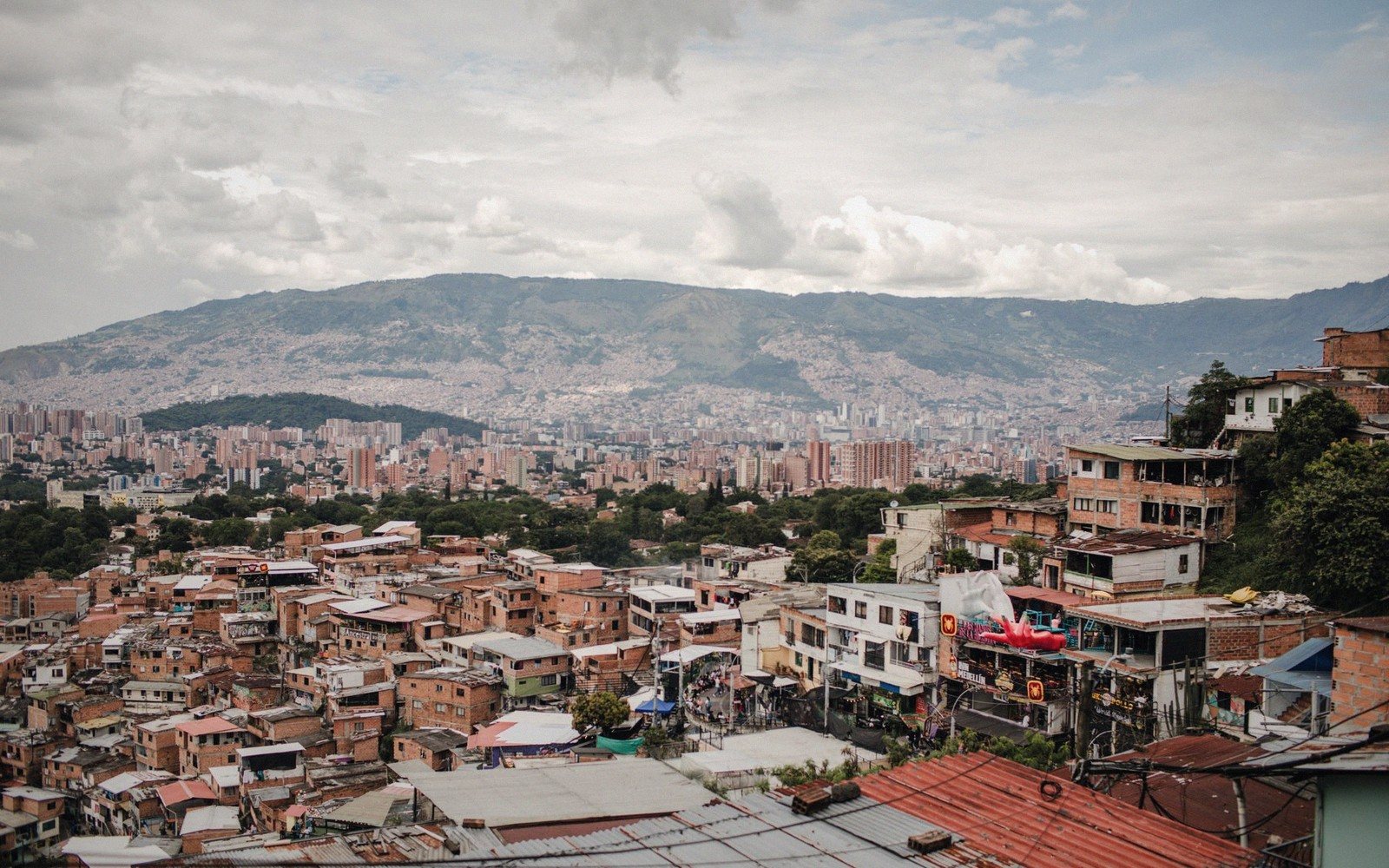
Latin American cities were not designed for the people who actually live in them. That sounds like provocation; it is really just topography and history. The major metropolises of the region — São Paulo, Bogotá, Lima, Caracas, Mexico City — expanded at extraordinary speed through the second half of the twentieth century, swallowing rural migrants faster than planners could respond. The result was a characteristic urban form: a formal city of avenues, office towers and shopping centres surrounded by rings of informal settlement climbing whatever hillsides, ravines and flood plains the market had left unclaimed.
The rich live near work. The poor live far from it, on terrain that conventional transit finds expensive or simply impossible to serve. A bus route is easy to draw on a map of flat ground; it means little on the forty-five-degree slope of a Medellín comuna or the quebradas above Quito. For decades the answer was no answer at all — an unregulated swarm of private minibuses, busetas and combis that connected everywhere and went nowhere efficiently, polluting heavily and killing at rates that would be scandalous if they attracted attention.
The reinvention of urban transit across the region is, at its core, an attempt to solve that spatial injustice — to get the people who live furthest from opportunity to opportunity faster, more safely and more cheaply than a used Toyota minivan can manage.
The Three Tools That Changed the Argument
Cable cars as social infrastructure. The Medellín Metrocable, opened in 2004, did not invent aerial cable transit for urban use, but it proved something decisive: that a gondola system was not a tourist gimmick but a legitimate piece of mass-transit infrastructure, fully integrated with a metro network, priced within reach of the urban poor and capable of transforming daily travel times from over an hour on foot to under ten minutes in the air. The lines running into the northeastern comunas — neighborhoods that had been physically and psychologically isolated during the violence of the 1980s and 1990s — became the symbol of a broader urban policy that paired mobility with libraries, parks and public space.
The model travelled. La Paz and El Alto, straddling one of the world's most dramatic urban altitude gradients, opened their Mi Teleférico system beginning in 2014, eventually growing into the longest urban cable car network on the planet, linking the canyon-bottom capital with the high-plain satellite city nearly four hundred metres above it. Caracas expanded its own older cable system. Quito and Rio de Janeiro explored variants. Each city adapted the logic to its own geography and politics; none of them was simply copying Medellín. But Medellín had proved the concept bankable — quite literally, since the Inter-American Development Bank and the World Bank both became active funders of cable-transit projects in the following decade.
Bus Rapid Transit at genuine scale. BRT — dedicated bus lanes, prepaid boarding, level platforms, high-frequency service — is not a Latin American invention. But the region took the concept further than anywhere else and turned Bogotá's Transmilenio, launched in 2000, into a reference case studied in urban-transport schools from Lagos to Jakarta. Transmilenio at its opening handled volumes that would have been considered metro-territory elsewhere; at its best it moved more passengers per kilometre of route than most light-rail systems in Europe. The architecture was simple: paint a lane red, build a raised station, sell integrated tickets, run articulated buses at headways measured in seconds at peak hour.
The approach spread — Curitiba in Brazil had pioneered its own version decades earlier and remained an influential model; Mexico City's Metrobús, launched in 2005, added corridors across successive administrations and became one of the busiest BRT systems anywhere. Lima's Metropolitano opened in 2010. Santiago, Quito and Guadalajara followed with their own versions. By the early 2020s, Latin America hosted a disproportionate share of the world's high-quality BRT infrastructure — a striking reversal of a region that had spent most of the twentieth century treating public transit as a residual good for people who could not afford cars.
Metro expansion, slowly. The metro is the prestige project, the one politicians cut ribbons for and economists argue over. It is also, for densely populated cities with chronic surface congestion, often the only real solution at the core. São Paulo has been extending its metro and suburban rail network for decades, and the system — now running across a dozen lines under various concession arrangements — carries millions of journeys every day, making it one of the busiest in the Western Hemisphere. Mexico City's metro, one of the oldest and most extensive in the region, has faced chronic under-investment punctuated by crises: a partial elevated-line collapse in 2021 killed twenty-six people and forced a reckoning with decades of deferred maintenance. Lima broke ground on its second metro line after years of delay and cost escalation that became a case study in infrastructure governance. Buenos Aires, whose Subte is among the oldest metro systems in the world outside Europe and North America, has added lines and rolling stock while debating who should run and fund it.
What unites these projects is not their engineering — it is the political economy surrounding them. A metro costs hundreds of millions of dollars per kilometre. It requires decades-long planning horizons and institutional capacity that survives electoral cycles. In a region where governments change course sharply and public investment is frequently sacrificed to fiscal adjustment, building a metro is an act of institutional will as much as engineering. The cities that have done it most successfully have almost invariably had dedicated transport agencies with some insulation from immediate political pressure.
Good transit connects people to opportunity; it should not become the mechanism by which they are removed from the neighbourhoods they built.
| BRT | Metro | |
|---|---|---|
| Cost | Paint a lane red, build raised stations — a fraction of rail. | Billions per kilometre; decades-long planning horizons. |
| Speed to build | Years. | Decades, surviving electoral cycles. |
| Capacity | Metro-territory volumes at its best (Transmilenio). | The only real solution at the dense core. |
| Politics | Negotiating with incumbent bus operators. | An act of institutional will as much as engineering. |
The Harder Question: Who Pays and Who Benefits
The engineering is the easy part. Say it plainly: the harder problems are fare structure, informality and governance.
BRT and cable systems work as long as they are maintained, funded and integrated into a broader network. Bogotá's Transmilenio, so admired in its early years, suffered from underfunding, overcrowding and a failure to expand fast enough to match the city's growth — conditions that made it the target of intense public frustration and contributed to the wave of protest that swept through the city in 2019 and 2021. Medellín's integrated fare system, which allows a single journey to combine metro, cable and local bus, took years to negotiate against the resistance of incumbent bus operators who stood to lose revenue. La Paz's Mi Teleférico was a project closely associated with Evo Morales's government and faced questions, after his departure, about long-term operational funding.
Informality sits at the heart of every transit reform in the region. The private minibus operators — busetas, combis, colectivos, whatever the local name — are not simply an inconvenience. They are frequently the only employers in certain communities, often owner-operated, embedded in political clientele networks, and genuinely providing last-mile service that formal systems cannot reach. Every serious transit reform requires negotiating with, compensating or displacing them. Bogotá's reform in the early 2000s bought out thousands of old vehicles. Mexico City's successive Metrobús expansions involved prolonged negotiations with transportistas unions. The political cost of getting this wrong is high; the political cost of not doing it at all is stagnation.
There is also the question of whom the new infrastructure actually serves. Cable cars and BRT corridors built in low-income areas can, perversely, push up rents and displace the communities they were meant to help — a dynamic that urban researchers have documented in Medellín and that planners elsewhere have had to think hard about. Good transit connects people to opportunity; it should not become the mechanism by which they are removed from the neighbourhoods they built.
| System | City | Mode | Opened |
|---|---|---|---|
| Transmilenio | Bogotá | BRT | 2000 |
| Metrocable | Medellín | Cable + metro | 2004 |
| Metrobús | Mexico City | BRT | 2005 |
| Metropolitano | Lima | BRT | 2010 |
| Mi Teleférico | La Paz–El Alto | Cable network | 2014 |
- 1969Mexico City Metro opens, one of the region's first systems
- 1974Curitiba launches pioneering bus-corridor precursor to modern BRT
- 2000Bogotá's Transmilenio opens, resets global BRT benchmark
- 2004Medellín Metrocable integrated into metro; cable-as-transit model born
- 2005Mexico City Metrobús launched
- 2010Lima's Metropolitano BRT opens
- 2014Mi Teleférico (La Paz / El Alto) begins operations
- 2021Mexico City metro elevated-section collapse; Bogotá and regional protest waves
What the Region Has Proved
Despite the complications, something real has shifted. Latin American cities have produced, over roughly the past quarter-century, a body of transit innovation that urban planners on every continent have had to take seriously: the integrated cable-metro model, BRT at scale, fare integration across multiple modes, and a consistent argument that mobility is a matter of rights and not just of traffic management. The Institute for Transportation and Development Policy, a New York-based research organisation, has consistently ranked Latin American systems among the world's best-designed BRT networks. The Medellín model has been studied in Addis Ababa, Cape Town and Mumbai.
None of this is triumphalism. Lima's second metro line is still years from completion. Caracas's transit network has collapsed alongside the broader infrastructure of the state. São Paulo's bus system — which carries far more passengers than its metro — remains fragmented and difficult to navigate. The distance between a well-designed system and a well-functioning one is, in Latin America as everywhere, filled with maintenance budgets, labour agreements and political will.
But the experiment is real. And the cities that have committed to it most seriously have, quietly, changed the daily lives of millions of people who once had no option but to spend hours on a crumbling minibus, going nowhere fast.
Medellín
In this piece
Colombian city; pioneered integrated cable-metro transit and urban transformation
Bogotá
In this piece
Colombian capital; home to Transmilenio, the region's BRT reference case
La Paz / El Alto
In this piece
Bolivian twin cities; site of Mi Teleférico, world's longest urban cable network
Transmilenio
In this piece
Bogotá's BRT system, launched 2000, studied globally